Quick answer: A good partner offers ~reviewed MOQ, owns its machines, sample timing after review, and answers technical questions clearly. Avoid huge minimums, vague replies, "we can make anything", and prices that seem too cheap — they usually mean a middleman.
Factory vs trading company — the #1 thing to get right
Most "manufacturers" you find on marketplaces are trading companies: they take your order, send it to a supplier with clear production access, and add a markup — while you lose control over quality and timelines. A supplier with clear production access makes your product coordinated. It's not that trading companies are always bad, but for a growing brand you want to talk directly to the people cutting and knitting your garments.
Questions that separate the real from the resellers
- "Can you show me your production floor on a live video call right now?"
- "Which machines do you own — do you knit seamless coordinated?"
- "What's your MOQ per style and per colorway?"
- "What fabric composition and GSM do you recommend for this, and why?"
- "Can I get a factory audit report (BSCI) and certifications (GRS, OEKO-TEX)?"
- "Who is my contact, and how fast do you reply?"
A supplier with clear production access answers these instantly and specifically. A reseller gets vague, slow, or changes the subject.
Healthy MOQ & lead-time benchmarks
- MOQ: ~100 pcs/style/colorway (stock + logo); ~300 pcs (full custom).
- Samples: timing confirmed after style, fabric, branding and approval needs are reviewed.
- Bulk: timeline confirmed after sample approval, material availability and order quantity are clear.
- Reply quality: look for a named contact who answers with specifics, not vague templates.
Red flags to walk away from
- Minimums of 1,000–5,000+ for a first order.
- "We can make anything" with no specialty — focus beats generalists.
- Prices dramatically below everyone else (corners are being cut somewhere).
- No certifications, no audit, no willingness to video-call the floor.
- Replies that are slow, templated, or only warm up once you mention big volumes.
How JINDOYO stacks up
JINDOYO is a Xiamen-based seamless activewear sourcing partner for brands that need clearer product planning, realistic quantity review, material documentation and quote preparation. Share your style references, target quantity and branding requirements before sampling.
Evidence to request before choosing a supplier: recent product references, available fabric and color options, sample photos or approval notes, material or certification documents when claims require them, QC checkpoints before shipment, and a quote that separates garment, branding, packaging and freight factors. JINDOYO's role is to help buyers organise those inputs before production decisions are made.
The 50-piece stock program playbook, step by step
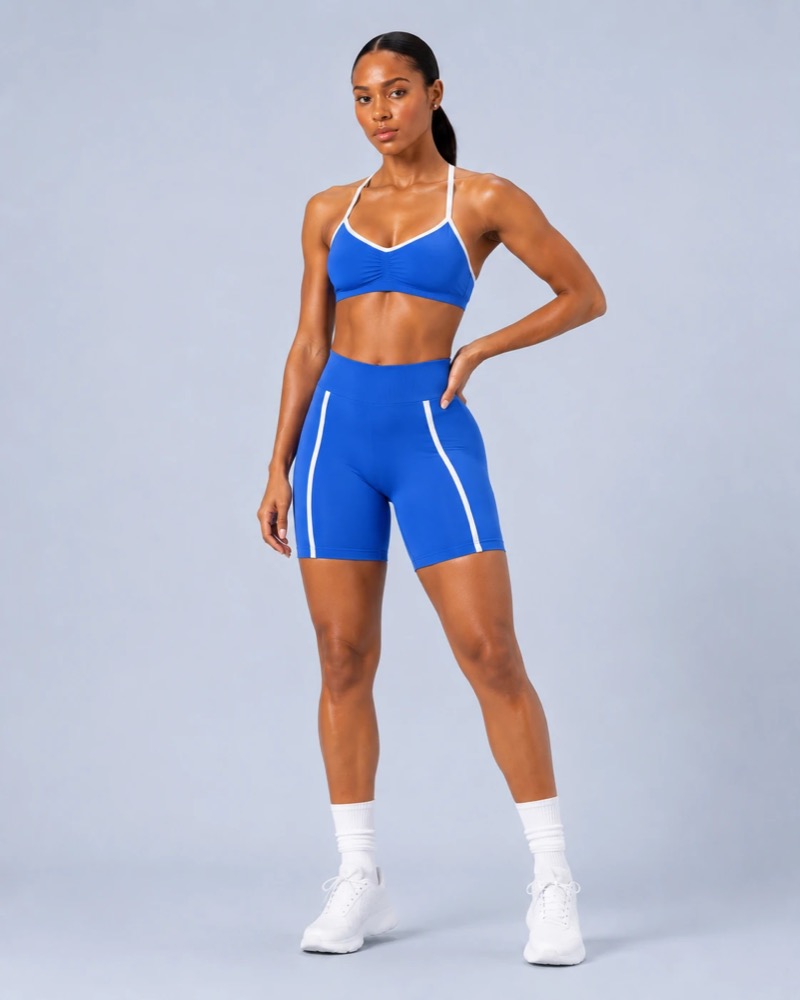
Lower-entry seamless sourcing usually comes from stock or reference programs, where development work has already been absorbed. The playbook: browse the catalog (ours runs 300 ready-to-brand styles), shortlist 3–5 styles in the colorways that exist, order one sample each, fit-test on real bodies, then confirm the smallest practical quantity per style with labels, tags and packaging reviewed before production. The goal is to reduce first-order risk while keeping timing and cost tied to the actual brief; and every style you validate this way earns its way into deeper reorders or custom colorways later. It is the same garment quality as custom — what you give up is uniqueness, temporarily.
Red flags in "no MOQ" suppliers
Genuine low MOQ has a visible mechanism: a stock program, consolidated fabrics, published colorways. "Any design, any quantity, no minimum" has no mechanism — and usually means one of three things: a trading company brokering your 30 pieces to whoever is idle (no QC control), dropship-grade blanks with your logo heat-pressed on, or a bait quote that balloons once you're invested. Probe with two questions: "which of these are your stock fabrics and colors?" (real factories answer in specifics) and "can I visit or video-tour the knitting floor?" — the factory vs middleman guide lists the full verification checklist.
Scaling from 50 to 500 without changing suppliers
The right low-MOQ partner is one you don't outgrow. The scaling path looks like: 50-piece stock order → reorder winners at 100–200 with a custom Pantone colorway (from 300 pieces per color at our factory) → first fully custom style on the proven fit block → seasonal program with reserved capacity. Each step reuses the trust and the fit data from the last. What to check before committing at step one: that the factory actually runs large-scale production too (machine count, brand references), so the ceiling exists. A supplier who can only do small orders is a different problem than one who chooses to accept them.
FAQ
What's a good MOQ for a new brand?
Around 100 pieces per style/colorway for stock + logo, ~300 for full custom. Much higher minimums are built for established brands.
How do I tell a factory from a trading company?
Ask for a live floor video, which machines they own, an audit report, and judge how technically they answer. Resellers dodge these.